SERVICE / Recovery & Retrofit

Recovery & Retrofit

Existing BMS Recovery, Retrofit & Managed Service

Assess existing BMS installations affected by interrupted support, incomplete records, mixed vendors or degraded operation, then recover critical functions, retrofit in stages and define continued managed service.

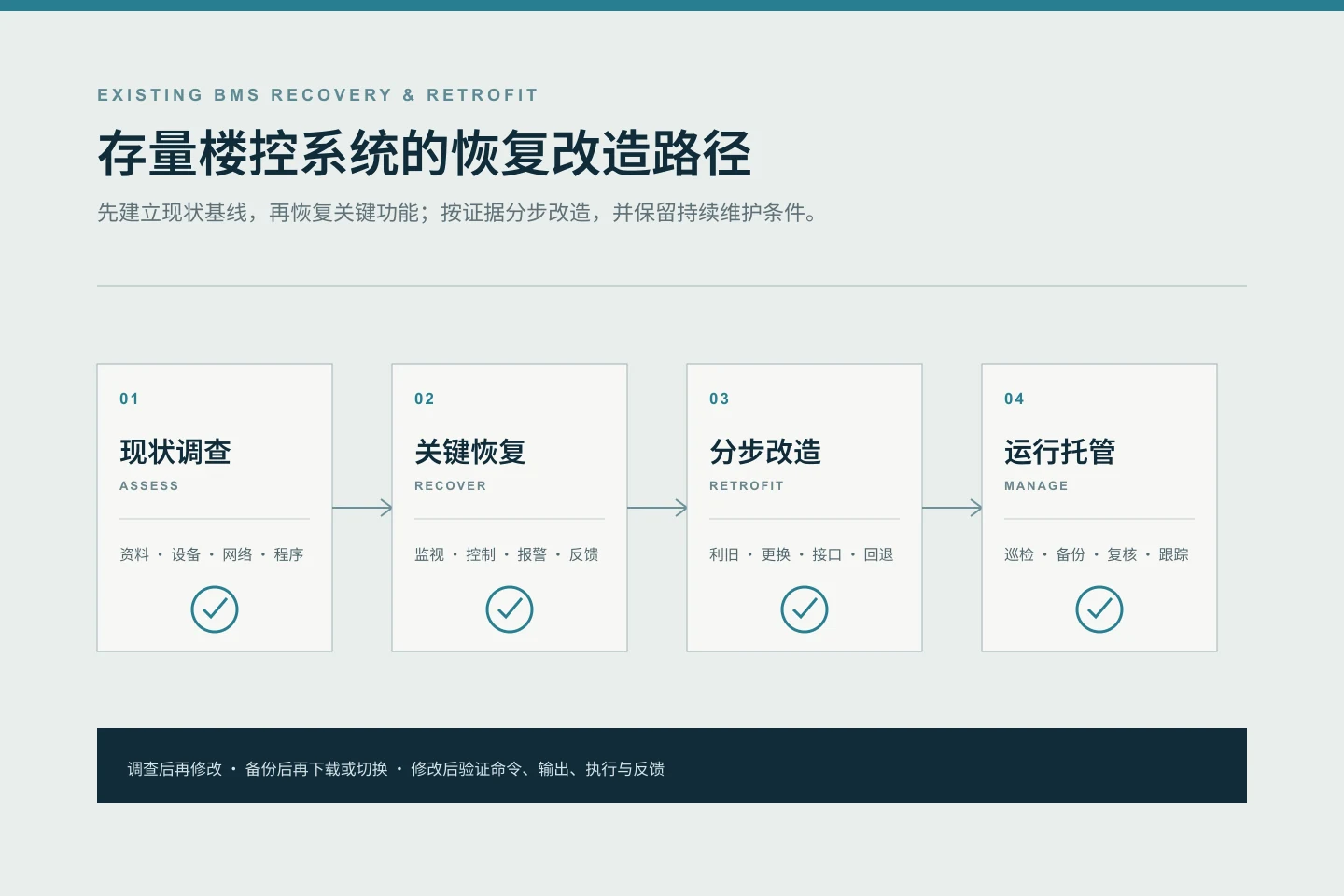
Original service-path diagram for assessment, recovery, phased retrofit and managed BMS operation

Recover real operation, then rebuild long-term maintainability.

01

The challenge

Existing BMS problems often span field equipment, points, programs, communications, the platform and operating practice. When support, records or backups are missing, the first need is a defensible baseline—not an assumption that every component must be replaced.

02

How we work

  • Start with available records and the current problem, then establish a baseline through desktop and site investigation
  • Under authorised and safe conditions, complete read-only inventory, necessary backups and tests while recording information gaps
  • Diagnose equipment, points, programs, communications, the platform and operating state before setting priorities
  • Recover critical monitoring and control first, then use evidence to choose repair, targeted upgrade or phased replacement
  • Verify command, output, physical action and feedback after changes, retaining test and handover records for continued service
03

The outcome

The commissioned scope produces a traceable condition and risk record with a practical recovery, repair or phased-retrofit path. Viable assets are retained, changes are verified, and any continued managed-service scope remains subject to a specific contract.


WHEN THIS SERVICE FITS

Start from the actual condition of the existing system.

An older system may still retain useful equipment and working relationships. The first task is to distinguish what remains usable from what has failed, degraded or cannot yet be confirmed.

01

The original manufacturer, integrator or service team can no longer support the site

02

The platform, controllers, sensors, communications or field devices are affected by faults

03

Equipment from different vendors, protocols and generations remains in service together

04

Drawings, point schedules, programs, accounts or backups are incomplete

05

The building must keep operating and cannot support a single full-system replacement

06

The system has persistent overrides, recurring alarms, offline areas or a long maintenance gap

THREE CONNECTED LEVELS

Assess first, recover what matters, then keep the system managed.

01

BMS assessment and diagnosis

Establish a traceable baseline first, separating confirmed faults, information gaps and conditions that still require site verification.

  • Survey controllers, sensors, actuators, communications, the supervisory platform and critical equipment
  • Check available drawings, point schedules, programs, databases, accounts and backups
  • Separate recoverable functions, repair needs, retrofit needs and items that cannot yet be determined
  • Set priorities and provide an initial delivery path, budget-level guidance and a condition and diagnostic report
02

System recovery and targeted retrofit

Recover necessary monitoring and control first, retain equipment that still has operating and maintenance value, then address components that have failed or cannot be supported sustainably.

  • Repair communications, point mapping, control logic, alarms, trends, graphics and necessary interlocks
  • Replace failed or unsupportable controllers, sensors, gateways and local equipment where evidence supports that decision
  • Connect or refine plant, HVAC, ventilation, lighting and energy-related systems where the agreed scope requires it
  • Manage interfaces across vendors, protocols and generations, phasing work by area, system or operating window
  • Retain backups, test evidence, verification steps and rollback paths under authorised and safe conditions
03

Annual maintenance and managed operation

Continued records, backups, reviews and follow-up reduce the risk of renewed loss of control, missing information or another break in technical support.

  • Perform scheduled inspections with fault response and remote support as defined by contract
  • Review alarms, communications, equipment status and manual overrides
  • Back up programs, databases, graphics and critical parameters
  • Review schedules, setpoints, interlocks and control strategies
  • Complete agreed minor changes and identify repair, replacement or upgrade needs
  • Track closed issues and provide inspection records and an annual system health report

WORK PROCESS

Investigate and back up before making changes.

Critical equipment requires confirmed authority, safety conditions and operating windows. After any change, command, output, physical action and feedback are verified and recorded.

Original service-path diagram for assessment, recovery, phased retrofit and managed BMS operation
A staged path with verification and rollback conditions retained at each transition.
  1. 01

    Receive available records and the current issue description

  2. 02

    Complete desktop review and site investigation

  3. 03

    Perform read-only inventory, backups and necessary tests under authorised and safe conditions

  4. 04

    Set diagnostic conclusions, priorities and phased recommendations

  5. 05

    Deliver recovery, repair or targeted retrofit and complete verification

  6. 06

    Organise handover records and move into managed service or follow-up

REPAIR, UPGRADE OR REPLACE

Choose the smallest responsible intervention supported by evidence.

Repair first

Use repair where faults are concentrated and the existing system, backups, spares and support conditions remain viable.

Targeted upgrade

Upgrade a specific layer when the platform, controllers or network are the clear constraint while other assets retain value.

Evaluate replacement

Consider replacement when several layers have failed broadly and there is no practical basis for recovery, spares or continued maintenance.

See the full engineering decision method ↗

DELIVERABLES

Records that support the next decision and future maintenance

Depending on the commissioned scope, deliverables may include the following. They are not all included by default.

  • System condition register
  • Equipment, network and point inventory
  • Fault and risk register
  • Retain, repair, replace and pending-confirmation scope
  • Priorities and phased recommendations
  • Program, database, graphic or critical-parameter backups
  • Point, communications, control and interlock test records
  • Modification and change records
  • Recovery or stage-acceptance records
  • Inspection records and annual system health report

WHY KIMMA

Engineering judgement across equipment, controls and continued operation

Multi-layer diagnosis

Assess equipment, points, programs, communications, the platform and operating practice as connected layers.

Evidence-led reuse

Do not force full replacement; first determine which assets retain operating and maintenance value.

One connected work path

Connect planning, supply coordination, programming, commissioning, recovery and continued service.

Multi-vendor coordination

Coordinate verified models, protocols, supply conditions and site resources across vendors and generations.

Operating result first

Focus on restored operation and future maintainability, not equipment supply alone.

Evidence-led decisions

A short communication path allows the delivery plan to respond to verified site evidence.

FAQ

Common questions before an assessment

01Can an assessment proceed with incomplete drawings, point schedules or programs?

Yes. The review can start from available records, platform state and field evidence, while missing information remains explicitly unconfirmed and may affect scope, timing and certainty.

02Must an older BMS always be replaced in full?

Not necessarily. The decision follows fault concentration, spares, access rights, records and maintainability before repair, targeted upgrade or replacement is selected.

03Can equipment from different vendors and protocols remain in use?

Models, protocols, interfaces, access rights and field condition must be checked. A multi-vendor site does not mean every device can be integrated or reused unconditionally.

04Is an assessment useful while the system is still running?

Persistent overrides, repeated alarms, missing backups or information gaps can justify a baseline assessment. The decision depends on operating impact and management needs.

05Can the assessment be commissioned separately?

Yes. It is a standalone paid technical service; recovery, retrofit or managed service can be decided separately after the findings.

06Is there a fixed price for assessment, recovery or retrofit?

No universal fixed price applies. Cost depends on system size, available records, site conditions, investigation depth and delivery scope.

07Will recovery or retrofit require shutdowns?

That depends on equipment, networks, cutover method and operating windows. Critical work requires agreed safety and shutdown conditions; zero downtime cannot be assumed.

08Does annual managed service include every repair, device and spare part?

Not by default. Inspection, response, remote or on-site coverage, minor changes, parts, equipment and out-of-hours service are defined by contract.

PROJECT & TECHNICAL ENQUIRIES

Need to request an assessment or share the condition of an existing BMS?

Send available platform screenshots, panel photos, equipment models, point schedules, backup status or a fault description. An initial discussion can begin even when records are incomplete.

PAGE POSTER

Share a clear project introduction