

SPECIALIST CONTROL

Laboratory Ventilation & Pressure Control

CONTROL OBJECTIVE

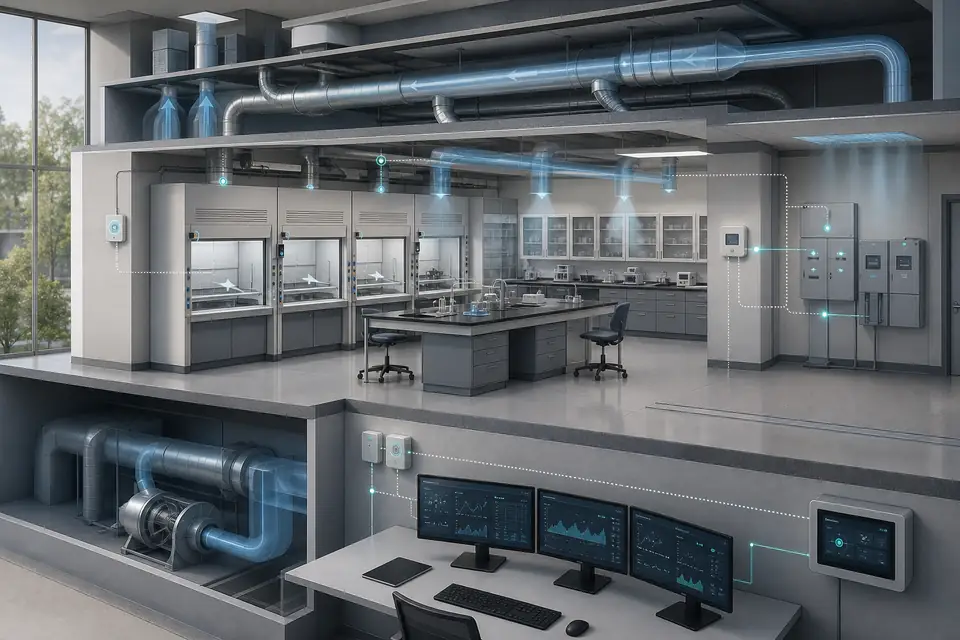
Coordinate fume-hood exhaust, make-up air, room supply and pressure control while balancing stability and ventilation energy within the confirmed safety boundary.

Original concept visual of exhaust, make-up air, pressure and monitoring coordination in a laboratory

WHAT THE SYSTEM MUST DO

Airflow balance, pressure response and equipment coordination

  • Exhaust and make-up air tracking
  • Fast room-pressure response
  • Equipment and safety interlocks
  • Trend, alarm and parameter review
01

The operating problem

Fume hoods and other local exhaust devices create changing airflow demand. If supply or make-up air does not follow, room pressure and environmental conditions drift; if pressure is pursued without limits, ventilation energy can rise unnecessarily.

02

The objective

For laboratory ventilation and pressure control, Kimma organizes the relationship between fume hoods, exhaust, make-up air, room supply and pressure. Fast response remains local while the platform manages status, alarms, trends and parameters.

03

How the system works

  1. Valid exhaust demand from fume hoods or local devices drives coordinated exhaust and make-up/supply airflow. Room pressure trims the overall balance with filtering and limits to avoid oscillation.
  2. Fan, damper, door and equipment feedback form defined safety interlocks and alarm responses. Final process-safety rules are confirmed with the responsible specialists.
  3. Trends combine airflow, pressure, temperature, humidity, commands and feedback. Reduced-flow modes are used only where the confirmed environmental and safety conditions allow.
04

The practical outcome

The system maintains clearer airflow and pressure relationships as laboratory use changes. Trends and alarms help diagnose deviations, while demand-led airflow and mode management can reduce unnecessary ventilation only within the confirmed safety boundary.

PROJECT & TECHNICAL ENQUIRIES

Seeing airflow, pressure or damper-control issues in a laboratory?

Share room relationships, supply and exhaust systems, damper and sensor information, design pressure and trends to frame the control chain and interlocks.

PAGE POSTER

Share a clear project introduction